
Following a conversation between Professor Cummings and Fr. Martin, Fr. Martin will read excerpts from his new book, titled Work in Progress: Confessions of a busboy, dishwasher, caddy, usher, factory worker, bank teller, corporate tool, and priest.
The event will take place at 7:00 p.m. in the Decio Auditorium of the DeBartolo Performing Arts Center.
]]>Read more about the award here!
]]>
“These are both vitally important areas for the future of Notre Dame and for society,” said McGreevy, the Charles and Jill Fischer Provost and Francis A. McAnaney Professor of History. “We are grateful to have such accomplished scholar-teachers willing to lead these campuswide initiatives, building on existing strengths and encouraging the kind of institutional collaboration Notre Dame needs to reach its full potential as the leading global Catholic research university.”
Chawla, the Frank M. Freimann Professor of Computer Science and Engineering and founding director of the Lucy Family Institute for Data and Society, will lead the new Data, AI & Computing Initiative, an effort focused on excelling in foundational research in these areas while enhancing interdisciplinary collaboration and real-world translation to address pressing societal challenges.
An expert in artificial intelligence, data science, and network science, Chawla is a Fellow of the American Association for the Advancement of Science, the Association for the Advancement of Artificial Intelligence, the Association for Computing Machinery, and the Institute of Electrical and Electronics Engineers. At Notre Dame, he holds concurrent faculty appointments in the Department of Applied and Computational Mathematics and Statistics in the College of Science and the Department of Information Technology, Analytics, and Operations in the Mendoza College of Business. He is also a fellow of several Keough School of Global Affairs institutes, including the Kellogg Institute for International Studies, the Kroc Institute for International Peace Studies, the Liu Institute for Asia and Asian Studies, and the Pulte Institute for Global Development.
“Nitesh is a superb scholar and recognized leader in data science and AI, not only at Notre Dame, but globally,” McGreevy said. “As an experienced and collaborative administrator with a strong sense of purpose, he is well-positioned to help us better ‘think as an institution’ to advance our research, teaching, and engagement in these areas while making a meaningful contribution to the common good.”
Chawla will continue to lead the Lucy Institute during the 2025–26 academic year, and an internal search will begin to select a new director for a term beginning in July 2026.
Cummings, the John A. O’Brien Collegiate Professor of American Studies and History, will direct the Global Catholic Research Initiative, a multifaceted effort to establish Notre Dame as a world leader in advancing research on the global Church and in fostering sustained reflection on the possibilities that Catholic perspectives offer in response to contemporary challenges.
“Kathy is a distinguished historian of American Catholicism, an award-winning teacher, and a talented administrator who led Notre Dame’s Cushwa Center for the Study of American Catholicism from 2012 to 2023 and sought to expand its global reach,” McGreevy said. “As director of the Global Catholic Research Initiative, she will help build scholarly partnerships to advance understanding of the global Church — where it has been, where it is, and where it might go in the future.”
National media outlets frequently turn to Cummings for expert commentary on the papacy and canonization. She is a past president of the American Catholic Historical Association, a concurrent faculty member in gender studies and Italian studies, and a fellow in the Keough-Naughton Institute for Irish Studies, the Nanovic Institute for European Studies, and the Ansari Institute for Global Engagement with Religion. Her current book project focuses on the globalization and modernization of the canonization process.
Over the last two years, Notre Dame has launched University-wide initiatives on poverty, ethics, democracy, health and well-being (including mental health and bioengineering and life sciences), sustainability, and the arts, while expanding support for the humanities through the Franco Family Institute for Liberal Arts and the Public Good.
“The strategic initiatives are designed to facilitate thinking and acting as one institution in order to make the most meaningful contributions to questions of national and international concern as Notre Dame fulfills its mission to be a force for good in the world,” said David Go, vice president and associate provost for academic strategy. “We have an outstanding group of visionary leaders directing these efforts, and I’m excited to add Nitesh and Kathy to that list.”
Chawla and Cummings have been appointed to five-year terms. Working closely with Go, they will each form an executive committee that will include academic leaders and faculty experts to help shape and implement the Data, AI & Computing and Global Catholic Research initiatives in the coming years, including developing fruitful collaborations with the other strategic initiative areas.
Originally published by at strategicframework.nd.edu on September 03, 2025.
]]>Originally published by at smacminor.nd.edu on August 06, 2025.
]]>Established in 1946, the Fulbright U.S. Student Program offers students and young professionals from all backgrounds the opportunity to study or teach abroad with support from the U.S. government.
In applying for the award, undergraduate students work closely with the Flatley Center for Undergraduate Scholarly Engagement (CUSE) and graduate students with the Graduate School’s Office of Grants and Fellowships.
"Given the headwinds of this year's Fulbright cycle, including funding uncertainty and later final notifications, Mathilda Nassar, Emily Buika Hunt and I are incredibly proud of our students for their grit and ultimate success,” said Elise Rudt-Moorthy, associate director of national fellowships at CUSE. “It was an honor working with everyone throughout the summer and fall, and we would like to thank all the faculty and alumni who helped with advising.”
Michael Skalski, associate program director in the Office of Grants and Fellowships, said, “We are very proud of and congratulate all our Fulbrighters this year. Our fellows worked hard and diligently on their applications, so we have the utmost confidence that they will represent Notre Dame and the U.S. in the best way possible in their host countries.”
The finalists are:
Undergraduate
• Aria Bossone, American studies and peace studies (supplemental), English teaching assistantship to Spain
• Charlotte Cardarella, honors anthropology and Arabic, English teaching assistantship to Spain
• Mary Kate Cashman, political science and peace studies (supplemental), English teaching assistantship to Kosovo
• Eva Garces-Foley, anthropology, peace studies (supplemental) and Spanish (supplemental), English teaching assistantship to Spain
• Juliet Hare, political science, global affairs (supplemental with a concentration in international peace studies) and French (supplemental), English teaching assistantship to Luxembourg
• Ethan Harned, psychology and pre-health studies (supplemental), Fulbright-Nehru open study/research award to India
• Sarah Hui, program of liberal studies and theology, open study/research award to Italy
• Joseph Kositzke, American studies, English teaching assistantship to Spain
• Joseph Lufti, American studies and Arabic, English teaching assistantship to Georgia
• Leslie Martin, global affairs and Latino studies (supplemental), English teaching assistantship to Colombia
• Matthew McCollum, honors international economics, English teaching assistantship to Germany
• Maria Murinova, program of liberal studies, English teaching assistantship to the Slovak Republic
• Margaret O’Brien, political science and Italian (supplemental with a concentration in Irish studies), English teaching assistantship to Italy
• Jasmine Peña Ramirez, political science and Latino studies (supplemental), English teaching assistantship to South Korea
• Theresa Salazar, preprofessional studies and theology (supplemental), English teaching assistantship to Spain
• Alexandra Sutton, political science, English teaching assistantship to Lithuania
• Sarah Van Hollebeke, political science and German, English teaching assistantship to Germany
• Juliet Webb, anthropology and peace studies (supplemental), English teaching assistantship to Senegal
Graduate
• Christopher Cirelli, master of education (Alliance for Catholic Education) English teaching assistantship to Italy
• Montana Garcia, master of education (Alliance for Catholic Education), English teaching assistantship to Malta
• Nicholas Herrud, history, open study/research award to Lithuania
• Natasha Rodgers, French and Francophone studies, English teaching assistantship to Mauritius
Originally published by at news.nd.edu on July 29, 2025.
]]>For Juan Hernandez, a keynote speaker and respected community leader, the mural is more than a tribute—it’s personal.
Several months ago, while presenting the next phase of the Foundry Field project, Carlson shared a historical photo featuring a group of young players from decades past. Among them was a young Hernandez.
That unexpected moment sparked a journey of reconnection, storytelling, and collaboration. Hernandez not only confirmed the players in the photo—he helped track down others, revive memories, and shape the narrative that would guide the mural’s design.
“The mural will provide another memory that adds to our stories which will be shared with generations for years to come,” Hernadez says.
“I am grateful for Hernandez’ impact on our community and proud that his and others' stories will be honored and shared through this mural at Foundry Field,” adds Carlson.
The mural captures the blend of imagination, resilience, and culture that defined life on the west side of South Bend. It honors not just the players, but the families and workers who made this league a source of pride.
“Yesterday is gone but not forgotten,” Hernadez says.
“Today we celebrate the stories of yesterday, and tomorrow, the stories of time will be heard on how the migrant workers, the organized farm workers movement, and the blended diverse cultures joining the Mexican American Baseball League is what has made the history of this league recognizable today.”
The mural dedication was hosted on Friday, May 9 from 4 to 6 p.m. at Foundry Field, with food trucks, music, and a celebration of culture, art, and sport. Several Notre Dame faculty and staff were part of the project, including Mike Hebbeler from the Institute for Social Concerns, Katherine Walden from American Studies, and Greg Bond from the Hesburgh Library.
This summer, through a partnership with the Robinson Community Learning Center (RCLC) where Hernandez works as the Civic Innovation Lab (CIL) youth development program director, he will return to Foundry Field—not just as a storyteller, but as a coach. As part of the CIL summer camp’s sports track, he’ll lead a group of kids in learning the fundamentals of baseball, using wiffle balls, plastic bats, and the same playful energy that once filled the field generations ago.
Check out the photo gallery below. Photos provided by Javi Zubizarreta from the Institute for Social Concerns.



Originally published by at publicaffairs.nd.edu on May 29, 2025.
]]>
The University of Notre Dame professor of American studies was born in Mauritius, a former French colonial island in the Indian Ocean, and grew up in a culture where the legacies of slavery, discrimination, racism, and religious plurality were ever present. This multicultural environment also allowed her to be linguistically diverse in English, French, and Creole — skills that would later be valuable in her professional life.
“It was a melting pot,” she said. “And that shaped me significantly.”
White’s parents were not from Mauritius and growing up, she was the only redhead she knew. That sense of being an outsider — coupled with a background she defines as privileged — instilled a distinctive perspective through which she could confront issues of race, gender, difference, and belonging.
Throughout her academic career, White has aimed to illuminate the lives and experiences of those often relegated to the margins — the enslaved, the “othered,” and the historically overlooked. Her work is rooted in archival research and utilizes diverse methodologies that underscore the complexity of the topics while also revealing singular stories within them.
“I want people to know that these sources exist,” she said. “We need to grapple with them and to hear those perspectives.”
In recognition of her work, White is the recipient of the 2025 College of Arts & Letters Research Award. The honor recognizes faculty who demonstrate significant scholarly achievement and impact, as well as leadership, innovation, and engagement with the University’s research and educational mission.
The award will be presented to White at the college’s spring faculty meeting at 3:30 p.m. Tuesday, May 6, in 215/216 McKenna Hall. Laura Knoppers, the George N. Shuster Professor of English Literature, will receive the Graduate Student Mentorship Award at the same event.
“As the liberal arts — and, really, the greater culture — reconsider questions of race, indigeneity, and power,” wrote Jason Ruiz, a professor of American studies and chair of the department, in nominating her for the award, “White’s work provides a touchstone for rethinking who has the ability to represent him- or herself as part of the historical record, and thus a part of American society.”
Initially trained as an art historian, White’s academic path gradually led her to American studies, which is intrinsically interdisciplinary. The field’s flexibility allowed her to utilize different methodologies, from archival research and material culture analysis to visual culture studies, literary analysis, and legal and religious history, innovations that have led to her being awarded three National Endowment for the Humanities fellowships.
“Exploring these different methodologies and different approaches to the past has been very freeing,” she said.
A concurrent professor in Africana studies, gender studies, and history, White’s research has largely focused on race and slavery in French colonies in the Americas, the Caribbean, and islands in the Indian Ocean.
In her first book, Wild Frenchmen and Frenchified Indians: Material Culture and Race in Colonial Louisiana, White examined material culture and religion to dissect the construction of race in 18th-century Louisiana.

She continued her focus on the topic of race with her second book, Voices of the Enslaved: Love, Labor, and Longing in French Louisiana, in which she conducted groundbreaking research by analyzing courtroom testimony from 18th-century enslaved Africans that offered an exceptional glimpse into their lives, through their own words.
“As you read these sources, they’re very moving, they are full of character, and above all, you will find that the individuals who testified kept insisting on their humanity,” said White, a fellow with the Klau Institute for Civil and Human Rights. “It has become a crusade for me to help propel research on such evidence, and to keep pushing the boundaries of what counts as an autobiographical slave narrative.”
Voices of the Enslaved won seven book awards, including the 2020 American Historical Association’s Rawley Prize in Atlantic history and the 2020 Frederick Douglass Book Prize for the best book on slavery.
White, also an affiliate with the Initiative on Race and Resilience, has extended this research with an edited volume on slave testimony in French and British societies. She has also sought to make it even more public-facing through a digital humanities project foregrounding four court cases containing testimony ranging from an elderly enslaved man to an enslaved 11-year-old girl. She is also a founding member of a major digital humanities project, “Keywords for Black Louisiana,” funded by the National Historical Publications and Records Commission.
“I think the success of the book is really a sign of how hungry we are to uncover new sources or to rethink how we interpret sources that we already know about,” she said. “And push those boundaries.”
For the last five years, White has also concentrated her research on another type of “othering” — against redheads.
“Clearly I’m drawn to thinking about the damage that some humans can do to others on the basis of color,” she said. “I’m just pivoting from skin color to hair color, one starting point addressing the Irish saying that ‘gingers have no soul.’”
Spanning from ancient Egypt to the 21st century, the project encompasses a book tentatively titled “Strangers Within: A Global and Genomic History of Red Hair,” as well as plans for an exhibition and a documentary. The research, funded by a NEH Public Scholars grant, will explore the cultural significance of red hair and reveal surprising connections to antisemitism and other forms of discrimination. White, also a fellow with Nanovic Institute for European Studies, said she has once again used many methods in her research for this project, including medical humanities and a field of DNA analysis called genomics.
Her research also lends itself to the classroom, where she challenges undergraduates to engage with primary sources and bear the moral weight of the past. In one project, White has students research the life of an enslaved person mentioned in early American newspaper advertisements.
“White’s work provides a touchstone for rethinking who has the ability to represent him- or herself as part of the historical record, and thus a part of American society.”
-Jason Ruiz, professor of American studies and chair of department
“I remind them that there were so many millions and millions of people who were enslaved in early America, but each one of those millions was a person, an individual just like them,” White said. “The statistics are important because they’re terrifying, and they should horrify us. But when we bring it down to the individual level, I think that’s when we fully grasp the horror of slavery and racism. And it’s an effective way for students to come to terms with that.”
For White, asking long-ranging, systemic questions about discrimination isn’t just for the sake of research — it’s also an ethical duty.
“To me, it’s a moral obligation to wrestle with slavery, and I get very emotional when I think about it,” she said. “In my own work, I feel the weight of those individuals who testified, and I feel a moral obligation to listen to what they’re saying and to try to understand. I might not have the final word on what they were hoping to communicate, but I at least want to encourage us to hear their words.”
Originally published by at al.nd.edu on May 02, 2025.
]]>
Jennifer Huynh didn't see herself in history until college, when she read the book Growing Up Vietnamese American. Now, she’s writing herself, her community, and her research into history.
Huynh, an assistant professor in Notre Dame’s Department of American Studies, has won a Russell Sage Foundation Pipeline Grant that will fund research for her second book project, “Unsettling Refugees: Southeast Asian Deportation and the Carceral State.”
The Pipeline Grants Competition, funded by the Russell Sage Foundation and the Bill & Melinda Gates Foundation, supports early career social sciences scholars from diverse backgrounds. The competition seeks out research that examines how people navigate systemic barriers to economic mobility and success.
It’s a perfect fit for Huynh’s scholarly work.
“Unsettling Refugees” will fill a gap in immigration research by giving voice to Southeast Asian refugees who live in immigration limbo. She hopes her book will contribute to multiple fields, including sociology, criminology, refugee studies, and Asian American studies.
“I was so ecstatic and excited about the award, especially since April commemorates the 50th anniversary of the end of the U.S. war in Vietnam,” Huynh said. “This research tells another interpretation of war and the afterlives of war from the people who experience it and their children.”
The topic of her research is a personal one for Huynh, whose father fought alongside Americans in the Vietnam War and was imprisoned in a reeducation camp, then fled the country by boat. Like many other Vietnamese refugees, Huynh’s father settled and raised his family in Southern California.
Huynh grew up in a large Vietnamese community, which inspired her first book, Suburban Refugees: Class and Resistance In Little Saigon (University of California, 2025). She describes the book as a mix of memoir and scholarship, and while working on the last chapter, Huynh interviewed Vietnamese refugees who were living in the U.S. under deportation orders but were unable to be deported.
She realized there was very little scholarship on and awareness of this group — a gap she partially attributes to the “model minority myth.”
“A lot of times, Asian Americans are just seen as this model minority, high-achieving — even Vietnamese are seen as highly educated and successful,” Huynh said. “But in reality, there’s a lot of our community members that are experiencing housing and economic insecurity and instability.”
Hmong, Laotian, and Cambodian communities are especially underrepresented. They make up a small population in the U.S., and their stories are often not represented in America’s history, Huynh said.
For her book, Huynh plans to expand beyond her Vietnamese community in Southern California to explore the experiences of Southeast Asians across the U.S. Most existing research on Asian Americans focuses on the West Coast, with nearly a third of the population living in California alone, but Huynh says research needs to look elsewhere in order to more fully understand Asian American experiences.
The opportunity to deeply examine important issues and increase representation is why Huynh entered the field of Asian American studies earning her bachelor’s degree from the University of California, Berkeley, and her Ph.D. in sociology from Princeton University.
“I don’t feel like my stories or my people’s stories or the U.S. war in Vietnam were well represented in my K-12 education,” she said. “So it wasn’t until I went to college and took a sociology class that I saw that I could be part of history.”
An additional obstacle for Huynh’s research — and understanding Southeast Asian stories as a whole — is the widespread belief that refugees are grateful beneficiaries of the U.S. resettlement program.
“This is a false narrative,” Huynh said.
In reality, Vietnamese refugees are not immune to the issues faced by other immigrant populations, including deportation.
Deportation is a different process for different countries; at times, the U.S. begins the deportation process, but the intended country won’t let the immigrant back in. Then they either have to wait in the U.S., regularly checking in with Immigration and Customs Enforcement, or they’re sent to wait in another country such as Panama.
The former is the case for many Southeast Asian refugees. More than 15,000 are currently living in the U.S. with orders of removal, but they can’t just let their lives stand still.
“What happens to people when they’re in this kind of immigration limbo?” Huynh asks. “What are your chances for social mobility or economic mobility for you and your U.S.-born children? What are your chances to get a job or rent a house?”
Unfortunate facts about refugees’ legal situation and systemic oppression, however, don’t paint a full picture of their experiences and can portray them as passive, faceless victims rather than resilient, complex individuals.
Through writing her book, Huynh wants to give people the opportunity to create their own self-portraits, to share their hopes and dreams as well as their trials.
“This research is important because it centers refugee stories and makes them take ownership of their narratives and their interpretation of history,” she said. “This is not the kind of data that you can get from quantitative studies or statistics.”
In addition to the financial support provided, the Pipeline Grant program will also pair Huynh with a more advanced scholar with a similar background doing similar work. She will use the funding to travel and conduct interviews with Southeast Asian refugees throughout the U.S., relying on collaborations with local Asian American organizations like The Ba Lô Project, a grassroots mutual aid organization.
She particularly hopes to find community members willing to help interview refugees who don’t share her background.
“I’m not from Cambodia or Laos,” Huynh said. “So I think stronger interviews will be from people within their own communities doing this fieldwork.”
Asking existing research subjects to refer potential participants — known as respondent-driven sampling — will help Huynh reach people whose voices are not usually heard.
While “Unsettling Refugees” will present findings on the impact of deportation orders on Southeast Asian refugees, Huynh hopes it will also humanize the community and break down stereotypes.
As a sociologist, Huynh aims to explain inequities through systems of inequality. She hopes her research can bring attention not only to Southeast Asians, but also to others caught in the aftermath of war.
“A lot of Americans had hard feelings about what happened after the Vietnam War, but we also have to look at it from the perspective of the Vietnamese people,” she said. “We have to look at it from the perspective of impacted communities and how the U.S. has created a militarized global empire — there are wars that we know little about that are erased from public memory.”
Originally published by at al.nd.edu on March 27, 2025.
]]>He was still a law student, interning with a human rights organization at the time, and felt unqualified to help the man on death row that he was about to meet. When the shackled man entered the room, Stevenson nervously informed him that he was not at risk of being executed in the coming year.
The man embraced Stevenson, and their one-hour scheduled meeting turned into a three-hour conversation.
“We just started talking and I forgot that I was a law student and he was a condemned person on death row,” Stevenson said on Oct. 15 while delivering the Institute for Social Concerns’ 2024 Rev. Bernie Clark, C.S.C., Distinguished Catholic Social Tradition Lecture.
But the more remarkable thing happened when the prison guards broke up that meeting and started to roughly push the condemned man out of the room and back down the hallway toward his cell.
The man closed his eyes, threw his head back, and started singing a hymn.
Stevenson, now an acclaimed public interest attorney and founder of the Equal Justice Initiative, recited that hymn on Oct. 15 to a hushed audience in the Morris Performing Arts Center in downtown South Bend.
I’m pressing on the upward way,
New heights I’m gaining every day;
Still praying as I’m onward bound,
“Lord, plant my feet on higher ground.”
Some 40 years after that meeting in Georgia, people ask Stevenson about the secret to his success. He and his staff have won reversals, relief, or release from prison for hundreds of clients. He’s won landmark cases at the U.S. Supreme Court. His memoir, “Just Mercy,” was adapted into a feature film with actor Michael B. Jordan starring as Stevenson.

Stevenson said he’s been able to find success for his clients not simply because he worked hard or had the right strategy.
“It’s because I got close enough to a condemned man to hear his song,” Stevenson said.
“And what I believe is that in poor communities all across the world, in places where there is suffering, and places where people have been marginalized in jails and prisons, and places where people have been oppressed and pushed down, there are still songs being sung,” he said.
“When you get proximate, you hear the songs. And those melodies in those songs will empower you, they will inspire you, and they will teach you what doing justice and loving mercy is all about,” he said. “That is why I’m urging you — all of you — to find ways to get closer to the poor and the excluded, the marginalized and the neglected, and to go with an open heart and listen for the songs that will teach you the things we need to understand.”
Get proximate.
Proximity is an approach to working alongside communities as well as a research methodology that the Institute for Social Concerns has employed in its scholarly work and in its pedagogy since 1983.
Tuesday was a pivotal moment in the institute’s 41-year history, as its name officially changed from the Center for Social Concerns to the Institute for Social Concerns. The slight change in name represents the decades-long evolution of the center into a university-level academic institute with faculty, students, and community partners from multiple disciplines and walks of life all working together to build a more just future — for the common good and for human dignity, face to face with or in proximity to marginalized communities.
Stevenson’s lecture was a fitting celebration of this moment, and encapsulated the power of the institute’s approach to research, to education, and to critical conversations.
In addition to being the Institute for Social Concerns’ first event as an institute, this was the first time that the Rev. Bernie Clark, C.S.C., Lecture was held off campus. The location at the Morris Performing Arts Center in downtown South Bend drew community residents as well as Notre Dame faculty, staff, and students.
The environment was electric inside the ornate, century-old theater as the audience listened to Stevenson. The silence of rapt attention was interspersed here and there with people calling out to voice their agreement. The crowd broke into applause multiple times during the lecture and gave Stevenson a standing ovation at the end of his talk.
“Change is often hard and messy. But I think everyone in that theater went home Tuesday night with an inspired sense that change for the better is possible, that it’s not naive to be hopeful, and that there’s a real framework for building a more just world,” said Suzanne Shanahan, the Leo and Arlene Hawk Executive Director of the Institute for Social Concerns.

“This is why the Institute for Social Concerns emphasizes proximity in our research and teaching, this is why we put human dignity at the core of everything we do,” Shanahan said. “It was beautiful for our community to be able to hear Bryan Stevenson express those same themes so powerfully.”
Throughout his lecture, Stevenson made his points through stories about real people he has encountered in his life.
He talked about children and young teens deemed by the courts to be “adults” and sentenced to serve time in adult prisons. He recounted the story of a Black woman in Alabama who had a tense meeting and then a profound connection with a white man she met on a remote dirt road while collecting soil from a lynching site. He described meeting an elderly man in a wheelchair who called his scars from the Civil Rights Movement his “medals of honor.” And he recalled an intellectually disabled man on death row who broke through his speech impediment to tell Stevenson “that I love you for trying to save my life.”
Stevenson’s stories underscored the reality of big issues like mass incarceration and racism, and how the individuals most affected by those issues experience them physically and emotionally in their lives.
And they illustrated the power of proximity.
But, Stevenson emphasized, proximity is not enough to raise what he called the justice quotient. The journey may start with proximity, but other steps need to follow.
One step is challenging and changing narratives that feed bigotry and hatred and violence. Those narratives lead people to tolerate things they should never tolerate, Stevenson said.
The idea in the criminal-legal system that “some children aren’t children” is a narrative that needs to end, he said. The narrative of white supremacy that was created to justify slavery in America has persisted and needs to be confronted, he added.
“When people hear me talking about slavery and lynching and segregation, sometimes they think I want to punish America for this history. I have no interest in punishment. My interest is liberation,” Stevenson said.
“I genuinely believe that there is something better waiting for us. There is something that feels more like freedom, more like equality, more like justice. It’s waiting for us, but we cannot get there if we do not find the courage to speak truthfully,” he said. “And people of faith have a particular role to play in this, because we are supposed to know something about this relationship between truth and redemption, truth and restoration.”

After getting proximate, and challenging and changing narratives, the next steps to raising the justice quotient are: be hopeful, and be willing to do uncomfortable things.
“We cannot allow ourselves to become hopeless about all of the ugliness and the violence and the division that we’re seeing around us,” Stevenson said, “because I am persuaded that hopelessness is the enemy of justice, and injustice prevails where hopelessness persists.”
He addressed Notre Dame students, faculty, and staff directly in challenging them to do their part to raise the justice quotient.
The University is a powerful institution with a remarkable history, he said, but he doesn’t believe it will be judged by success in athletics or accomplishments in the classroom. “I believe we’re going to be judged by the percentage of people in this community that are willing to get proximate to the poor and the excluded, to change the narratives, to stay hopeful.”
In addition to being this year’s Rev. Bernie Clark, C.S.C., Distinguished Catholic Social Tradition Lecture, the event with Stevenson was also part of the 2024-25 Notre Dame Forum, which is organized around the theme “What do we owe each other?”
The lecture was co-sponsored by several other units at Notre Dame: the Department of American Studies, the Klau Institute for Civil and Human Rights, the Initiative on Race and Resilience, the Law School, and the Office of the President.
]]>Stevenson’s talk is scheduled for 6 p.m. on Tuesday, Oct. 15, at the Morris Performing Arts Center in downtown South Bend. Everyone in the community is invited, there is no cost to attend, and no ticket is required. Doors will open at 5 p.m. A free shuttle will be available between Notre Dame’s campus and downtown on the evening of the event.
Stevenson’s talk is this year’s Rev. Bernie Clark, C.S.C., Distinguished Catholic Social Tradition Lecture. Established in 2009, the lecture invites exemplars from across diverse fields who share the Center for Social Concerns’ abiding commitments to human dignity and the common good.
Stevenson’s lecture is also part of the 2024-25 Notre Dame Forum, which is organized around the theme “What do we owe each other?”
University President Rev. Robert A. Dowd, C.S.C., will introduce Stevenson at the event.
“It is a privilege to welcome a leader whose public life has been guided by the question at the heart of this year’s Notre Dame Forum in the way that Bryan Stevenson’s has,” Father Dowd said. “For more than 30 years he has worked with tireless commitment to advance economic and racial justice in our country, and his example is an inspiration to us all.”
This is the first time that the Rev. Bernie Clark, C.S.C., Lecture is being held off campus in South Bend.
“I cannot imagine a more perfect person than Bryan Stevenson to serve as this year’s distinguished lecturer. His lifelong commitment to justice has been extraordinary,” said Suzanne Shanahan, the Leo and Arlene Hawk Executive Director of the Center for Social Concerns.
“To be hosting this conversation in the heart of our community makes it even more special,” Shanahan said. “We are thrilled that we will all be able to benefit from Stevenson’s experience and wisdom. Our hope is that we will share in those challenging conversations about racial justice as we together aspire to a more just carceral system.”
Stevenson is the founder and executive director of the Equal Justice Initiative, a human rights organization based in Montgomery, Ala. His memoir, “Just Mercy: A Story of Justice and Redemption,” became a bestseller and was adapted into a feature film in 2019 starring Michael B. Jordan, Jamie Foxx, and Brie Larson.
Stevenson has won multiple U.S. Supreme Court cases, including a 2019 ruling that protects condemned prisoners who suffer from dementia and a 2012 ruling that banned sentences of mandatory life imprisonment without parole for children 17 or younger. He and his staff have won reversals, relief, or release from prison for more than 140 wrongly condemned prisoners on death row and won relief for hundreds of others who were wrongly convicted or unfairly sentenced.
In addition, Stevenson led the creation of the Equal Justice Initiative’s Legacy Sites, which include the Legacy Museum, the National Memorial for Peace and Justice, and Freedom Monument Sculpture Park. These powerful new landmarks in Montgomery chronicle the nation’s legacy of slavery, lynching, and racial segregation while making connections to today’s crisis of mass incarceration and contemporary issues of racial bias.
The Center for Social Concerns at the University of Notre Dame is an interdisciplinary institute responding to the complex demands of justice through a combination of justice education and research for the common good. The center brings people together to think carefully about the world’s most pressing social concerns in order to develop creative and effective approaches to addressing them.
Stevenson’s lecture is co-sponsored by several other units at Notre Dame: the Department of American Studies, the Klau Institute for Civil and Human Rights, the Initiative on Race and Resilience, the Law School, and the Office of the President.
Find more details about Stevenson’s lecture, including location, parking, and shuttle information, at socialconcerns.nd.edu/bernieclark.
]]>“Ableism is a system of power and privilege that hierarchically ranks those with perceived able bodies over people with disabled bodies. Ableism teaches us that body and mind normativity is preferrable,” said Daen, assistant professor of American studies. “Ableism is also discrimination against disabled people based on a belief that these people are less than or not worth the same as able-bodied people, and it results in oppressions and marginalization.”
Such attitudes are known to have existed in Early Modern English and Colonial American laws and policies. As the new republic was created, men and women with disabilities were not seen as citizens and were not allowed to vote, marry, own property, or settle in certain towns.
As the United States marks 34 years since the signing of the Americans with Disabilities Act (ADA), Daen cautions that the United States still has a long way to go in creating welcoming spaces for people who have disabilities. “In the same way that racism and sexism have existed for millennia, ableism certainly still exists today,” she said. “It’s this big amorphous thing that exists structurally, interpersonally, and internally. For example, you might hold ableist ideas about yourself.”
The ADA has ushered in a great deal of opportunity and access for the disabled community in everyday activities, but the guidelines are not always followed. Neither, says Daen, can the law remove the stigma of disability or deeply held prejudices that non-disabled people might hold. As a result, physical and cognitive impairments may be perceived as a negative experience and people with those impairments may be ignored, excluded from activities, presumed to be helpless and unable to make decisions, or coddled.
It is possible, however, to become less ableist in our behaviors and beliefs. Daen says the simplest way to do so is by simply engaging with disabled people. Campus organizations like ND Ability and Access-ABLE ND offer great opportunities to attend a meeting or event and support their initiatives. Service programs like ND Bridge often work with community organizations that serve constituents with intellectual, developmental, or physical disabilities.
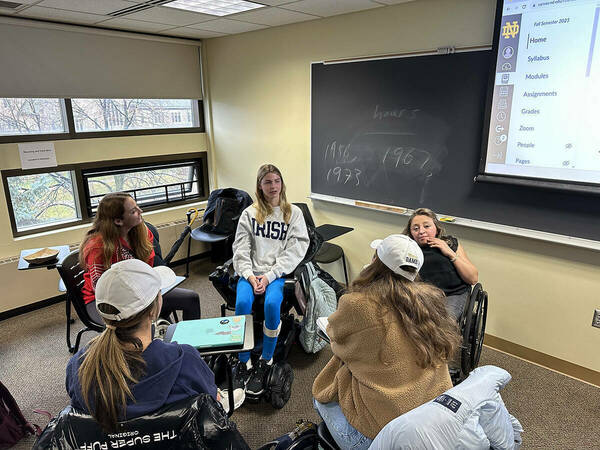
There are also classes in the College of Arts and Letters’ Disability Studies program, like Disability at Notre Dame–-one of the courses Daen has taught. In the class, students were given $5,000 to spend on campus to enhance accessibility. “I’ve taught it twice. Students have great project ideas—everything from increasing signage in the dining halls about food allergies to social media campaigns that raise awareness about mental health. The biggest project has been trying to have American Sign Language (ASL) recognized as a foreign language on campus,” said Daen.
Most importantly, if you’re advocating for accessibility and inclusion, listen to the voices and lived experiences of the disabled community. “Disabled people have wisdom and knowledge about their bodies and minds that supersedes other types of knowledge,” you might gain through theoretical concepts, Daen said. “The disability rights movement is centered on the idea of ‘nothing about us without us.’ Disabled people should be leading some of these initiatives. They are the experts.”
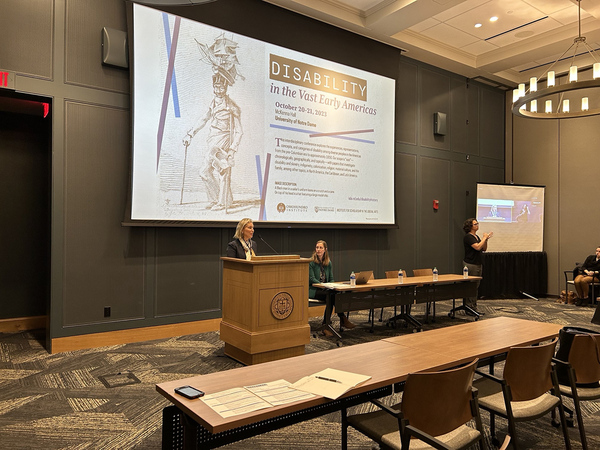
Daen took this advice to heart when organizing the Disability in the Vast Early Americas conference in October 2023. The hybrid event, believed to be the first disability history conference in more than 20 years, was held on Notre Dame’s campus. Daen and other organizers worked hard to ensure that they created a space that felt comfortable for everyone and that allowed people to engage at all capacities. “We talked to people and asked what they would need, and that conversation led us to create rest spaces where people could go to take a break during and between sessions,” she said. Participants also wore masks in consideration of people who had immunodeficiencies. Presenters were asked to use plain language and speak slowly so their content would be more accessible to someone with a cognitive or hearing disability. And visual materials were created in high contrast for better readability by someone with a visual impairment.
The hybrid format allowed participants with issues traveling to participate, and the video setup allowed their faces to be shown in large detail so it felt like they were in the room along with the in-person attendees. Organizers also made the decision to offer ASL interpretation whether or not a conference participant asked for it.
It wasn’t an easy or inexpensive process, but Notre Dame Studios and University Enterprises and Events were receptive to all of the organizers’ ideas and helped to make the event a success for the 49 presenters and more than 130 people who attended. One person told Daen it was the most accessible conference they had ever been to.
For the 2024-2025 academic year, Daen is working to finalize her book, tentatively titled “Capacity for Citizenship: Disability, Rights, and Resistance in the Early United States.” A continuation of her dissertation, the book details “how exclusions were imagined, implemented, and enforced with repercussions for disabled people” in early America. “There’s a lot of research about certain groups of people, but I feel like disabled people are left out and often overlooked. So I’m really happy to reinsert [disabilities] into the conversation when we can,” she said.
Originally published by at diversity.nd.edu on July 25, 2024.
]]>
Researchers at the University of Notre Dame now have complete online access to more than 150 years of South Bend history, thanks to a recent acquisition by the Hesburgh Libraries.
The new resource, attained from NewsBank, is a full-text, searchable newspaper archive of the South Bend Tribune from 1873 to 2018.
“Acquiring the complete South Bend Tribune archive was a collaborative effort with Notre Dame faculty several years in the making,” said Mark Robison, interim program leader of Collection Strategy and Acquisitions and political science and peace studies librarian at the Hesburgh Libraries. “Having access to the South Bend Tribune back to its earliest issues has opened countless doors to our students to help them better understand our local and national history.”
The electronic database allows users to see full scans of each available issue, giving researchers the opportunity to view articles in context, exactly as they were printed, including photos, graphics, advertisements and other page content.
The addition of the database closes a gap in the library’s digital holdings. Prior to the acquisition, library patrons could access full scans of the Tribune only from 2018 onward, an incomplete run of microfilm from 1966 to 1971 or HTML-formatted text articles from 1994 to 2017. Now, the full archive from 1873 to the present day will be accessible to researchers from the Notre Dame community.
“The South Bend Tribune is proud to be the best source of local news for more than 150 years,” said a spokesperson from the South Bend Tribune.
The South Bend Tribune has been the city’s newspaper of record since its early days. It was founded in 1872 as a weekly and became the city’s first daily newspaper in May 1873.
“The Daily Tribune is an enterprise worthy of the thriving little city of South Bend,” said a June 1873 issue of the Scholastic, Notre Dame’s then weekly newspaper, which still runs today as a monthly news magazine.
"From the coverage of major social and political events, to the discussion of contemporary national issues, to the design and placement of advertisements, it is hard to overstate how much having access to a complete, full-image, primary source record of local events will benefit our students’ research and learning."
Because of the many historical ties between South Bend and Notre Dame, the database is an essential primary source for scholars researching local or University history. It also helps provide insight into local or regional perspectives on national or international historical events.
“From the coverage of major social and political events, to the discussion of contemporary national issues, to the design and placement of advertisements, it is hard to overstate how much having access to a complete, full-image, primary source record of local events will benefit our students’ research and learning,” Robison said. “Many faculty across campus helped advocate for this important resource, knowing the value it would add to their courses.”
When advocating for the Hesburgh Libraries to acquire this archive in 2023, Annie Gilbert Coleman, associate professor of American studies, said that she would use the database regularly in the classes she teaches such as Sports and American Culture, Sports and the Environment, American Wilderness, and her American studies senior seminar on sports and recreation. She said obtaining access to the Tribune archive was “vital” to the success of the minor in sport, media and culture.
“The main goal of the minor is to get students thinking critically about the culture and politics of sport. While that can take many forms, analyzing journalism related to sport and community is central to that endeavor,” she said. “So, too, is researching sport history through primary source materials and thinking critically about the relationship between sports, local government, businesses and community institutions. Local newspaper archives provide irreplaceable source materials for our students and faculty engaged in this work.”
Katherine Walden, assistant teaching professor of American studies, also supported acquiring the database for students in her sports history classes.
“For classes I teach like Baseball and America, Football in America, and Sport and Big Data, as well as the constellation of ND courses focused on aspects of sport, history, community and identity, having access to these materials would facilitate historical research and primary engagement efforts that ultimately deepen Notre Dame’s connection with the surrounding community,” Walden said.
Members of the Notre Dame community looking to use the South Bend Tribune database can do so from anywhere in the world by visiting the Hesburgh Libraries databases and searching South Bend Tribune. Visitors to campus and members of the public may also access the Tribune archive and other library e-resources using the library’s guest computers located on the first floor of the Hesburgh Library.
For more information, contact Mark Robison, Hesburgh Libraries.
Originally published by at news.nd.edu on April 02, 2024.
]]>The journal, which has been at the forefront of American studies research and discourse, will be led by Jason Ruiz, associate professor and chair of the Department of American Studies.
“For us to host AQ, it does feel like we are really getting our name out there and showing our field that we're a force to be reckoned with,” Ruiz said. “We're producing top-notch scholarship as a faculty, and the journal will be a platform for us to publish similarly quality work.”
The publication was housed at the University of Hawaii for the last decade. It was led by editor-in-chief and professor Mari Yoshihara, who guided the journal in new directions, including a particular focus on transpacific American studies.
In coming to Notre Dame, Ruiz plans to maintain AQ’s high standards and also hopes the new editorial team — comprised of associate editors and Notre Dame faculty Perin Gürel and Korey Garibaldi, as well as Benjamin Balthaser of Indiana University South Bend — will consider and highlight different points of scholarship in the American studies field, particularly honing in on subjects pertaining to the Midwest and its misconceptions.
AQ was founded at the University of Minnesota in 1949, but has not been housed in the Midwest since. Ruiz believes this is an opportune time to reexamine the region's meaning to the U.S. and the world.
“We will have an eye toward publishing work that tries to reconsider this part of the country as something other than flyover country,” Ruiz said. “We want to focus on the global Midwest and the idea that the region is not in an isolated place, but has rich important global connections.”
With faculty that specialize in a wide variety of diverse studies, Ruiz believes his editorial board and department will help the journal continue to thrive and encourage forward-thinking interdisciplinary research.
“It’s so important to have a strong editorial team because they're making some of the very first important decisions that really shape the journal,” he said. “Because they — and we, collectively — will be deciding what our focus is and what the journal absolutely has to cover to represent this diverse tapestry that is American studies.”

Notre Dame now has the largest undergraduate American studies program in the world, and the department was unanimously selected to house AQ by a board through a rigorous decision-making process. Ruiz believes the AQ board considered the state of academia and that the American studies department at a leading research university is on the precipice of something great.
“In a world in which public universities are contracting in the humanities in so many ways, Notre Dame takes the humanities very seriously and will put the resources and the effort into it, and I think that really impressed the board,” he said.
The weight of taking on a well-respected publication has not been lost on Ruiz. But, in addition to support from the College of Arts & Letters, Ruiz will have two postdoc fellows who will help manage the workload and enhance the department’s intellectual vibrance. And, with that support, he believes they are equipped to succeed.
“It is a seriously challenging thing to consider how we develop new systems that work for us but honor the rigor that Hawaii has really instilled into the journal over the past 10 years,” he said. “By building up a staff and building up a community of people to work together on this, thanks to support from the dean’s office and the University, it’s an exciting way to meet that challenge.”
Originally published by at al.nd.edu on April 02, 2024.
]]>Professor Pinto will be coming to Notre Dame on Monday, February 5th, to give a talk titled “Not Your Mother’s Hematology.” The talk will center around answering what “blood,” as material and metaphor, has meant to the study of race. The talk will take place in room 330 of O’Shaugnessy Hall, from 3:30 pm to 5:00 pm. We hope to see you there!
]]>